
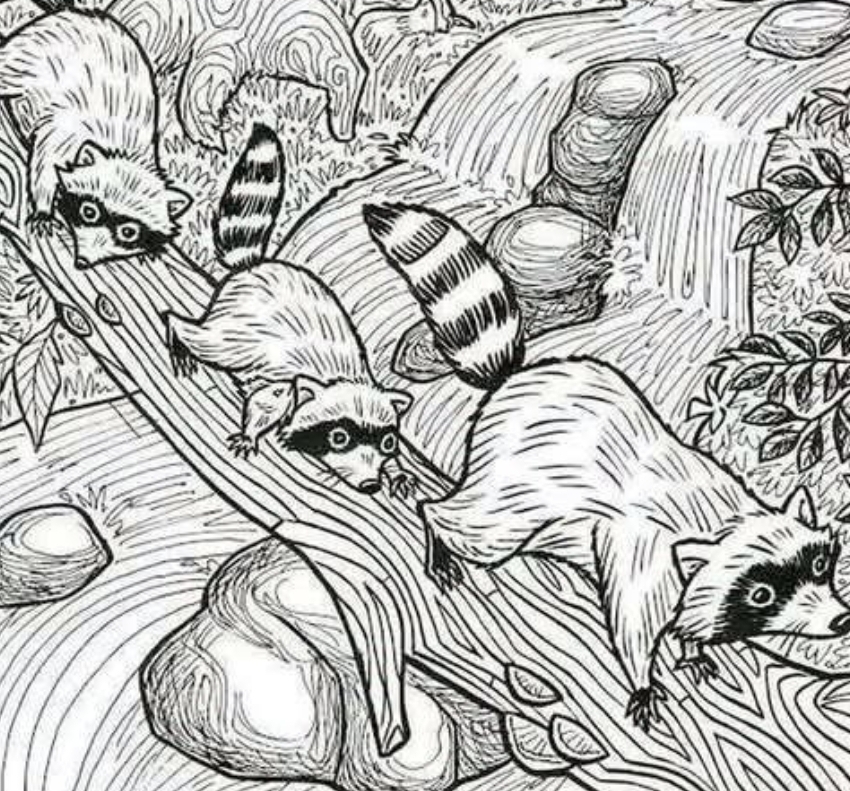
Can You Find the Hidden Bird? This Forest Optical Illusion Will Test Your Observation Skills
At first glance, this black-and-white optical illusion looks like a peaceful forest scene filled with raccoons, trees, rocks, and a small stream. The detailed drawing gives your eyes plenty to explore—but somewhere within those natural shapes, a cleverly hidden bird is waiting to be discovered.
The challenge sounds easy: find the hidden bird.
But there’s a reason many people have trouble spotting it.
Your attention is naturally pulled toward the most recognizable objects in the picture, especially the raccoons, tree trunks, rocks, and other obvious details. Meanwhile, the bird is cleverly blended into the surrounding scenery.
Can You Find the Hidden Bird?
The artist has designed the bird so that its shape becomes part of the forest background.
Instead of standing out clearly, the hidden figure is disguised using lines, shadows, shapes, and surrounding details. At first, your brain may simply interpret these patterns as part of the trees, rocks, or other elements in the scene.
That is what makes this type of visual puzzle so challenging.
You aren’t necessarily looking at the wrong part of the picture. Your eyes are simply being encouraged to interpret the image in the most obvious way first.
Why Is the Bird So Difficult to See?
When you look at a detailed picture, your attention tends to settle on familiar objects.
A raccoon looks like a raccoon.
A tree looks like a tree.
A rock looks like a rock.
Once your brain identifies those objects, you may stop examining the individual lines and shapes that make them up.
The hidden bird takes advantage of exactly that tendency.
Its outline is integrated into the surrounding details, making it much easier to overlook.
A Simple Trick That May Help
Instead of staring only at the center of the image, try changing the way you examine the scene.
Slowly scan the picture from top to bottom and from one side to the other.
Pay attention to:
- Unusual shapes
- Unexpected curves
- Gaps between objects
- Dark and light areas
- Lines that seem slightly out of place
- Shapes that could form part of an animal
Try not to focus exclusively on the raccoons or the largest tree.
Sometimes the hidden figure becomes easier to recognize when you stop looking for a complete bird and instead search for parts of its outline.
Take Your Time
Many people immediately assume that they should be able to spot the answer within a few seconds.
Don’t worry if you can’t.
These puzzles are designed to make the hidden object blend into the surrounding illustration. Taking your time and deliberately shifting your attention can make a major difference.
You may even find that once you finally see the bird, it suddenly seems obvious.
That is one of the most enjoyable parts of a good optical illusion.
Ready to Test Your Eyes?
Take another look at the forest scene.
Ignore the obvious subjects for a moment and carefully inspect the smaller details.
Can you find the hidden bird?
Scan the image from top to bottom. Look at the edges, spaces, shadows, and unusual patterns.
Don’t give up too quickly—the bird is cleverly concealed within the scenery.
Did You Find It?
If you spotted the bird without help, you have a sharp eye for visual details.
If you didn’t, don’t worry. The puzzle is specifically designed to make the hidden shape blend into the surrounding scene.
And once you know where the bird is hiding, you may wonder how you missed it in the first place.
That’s the fun of optical illusions: the image doesn’t change, but the way you see it does.
Final Thought
Hidden-object puzzles like this are a fun way to challenge your observation skills and encourage you to look at familiar shapes from a different perspective.
So take one last look at the forest.
Can you spot the hidden bird before someone else does?